“In the end, we will conserve only what we love; we will love only what we understand and we will understand only what we are taught.”
— Baba Dioum

Dealing with the climate crisis today can be frustrating if approached without tangible examples and perspectives capable of inspiring the belief that new paths and horizons are possible (isn’t that how hope and motivation are sparked?).
If by climate issues you mean the search for practices of care and harmony, then feel at home!
And if we add the study of permaculture to all this, we are faced with something truly unique!

Hi, we are Marco Cantarella and Rossana Di Guardia, activists with S.C.I. Italia and co-founders of the local S.C.I. Catania group.
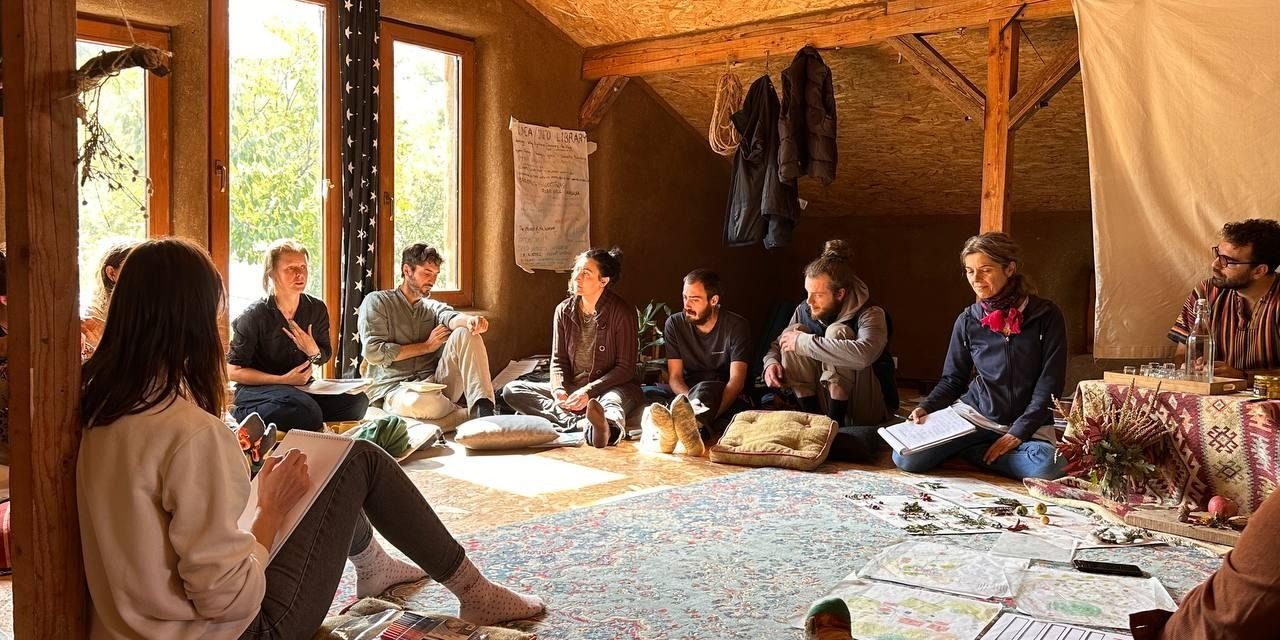
Together with 18 other participants, we took part in the Permaculture Design Certificate (PDC) training course from October 2 to 15, 2025, led by expert facilitators Pippa Buchanan and Andrea Fiore, professionals in the field, and hosted in Bozevce, at the Gaia Kosovo nursery, a branch of S.C.I., an association with a strong ecological footprint and community spirit, which lives and evolves in an inspiring context, where land, animals, plants, people, and vision intertwine in the daily lives of Helena, Maya, and Alex, some of the beating hearts of this organization.
It is practically impossible to recount in detail what we experienced during these two weeks, as there are too many intertwined aspects: from interpersonal relationships to living alongside the wonderful animals, plants, and flowers that inhabit Gaia Kosovo; from the delicious and nutritious meals expertly cooked by Brazita, Maya, Helena, and Sarina using local products; from studying the principles and ethical values of permaculture to designing nurseries, ponds, and rainwater drainage systems, to evening music jam sessions, from celebrating two birthdays to the traveling Balkan music group for Slava Day, from visiting and supporting the monastery of Orthodox monks who are friends and partners of the association to sharing social projects between Romania, Montenegro, and Serbia, and much more.
But there is one emblematic story we would like to share with you that gives you a glimpse of this experience:
How to implement a project in a state of emergency: nema struje

On the second day of training, in Bozevce, the first snowflakes fall unexpectedly for the season.When we wake up, the valley is covered in a white blanket; the branches of the trees, weighed down, begin to break, and the electricity goes out for several days, along with hot water, heating, and Wi-Fi.
How could we continue with two weeks of intensive training with 25 people living together in the same space?
No panic, we are with Gaia Kosovo!
Despite all these difficulties, which would have caused many organizations to collapse, everything went smoothly, in a serene and peaceful atmosphere.
We often use words without fully understanding their meaning,
but in this case, the term resilience has become a living, tangible experience.
We have been able to experience firsthand how Gaia Kosovo fully embodies the ability to adapt, to let itself be affected by climatic vulnerabilities, and to face problems with awareness and creativity.
This organization has shown us the importance of preparing for risks and, above all, facing uncertainty with patience and clarity and flowing with it.
In fact, extreme or abnormal weather events—such as heavy snowfall out of season or prolonged power outages—made us all feel so fragile, but not weak or afraid.
This made the training experience deeply real, strengthening our ability to live on the margins of modern comfort and adapt to emergency and unpredictable situations.
Participants and organizers thus merged into a single collective body, capable of understanding, supporting, and functioning harmoniously.
Immersed in an authentic living case study, the PDC offered us, day after day, a new lens through which to observe life. It gave us a scientific and value-based key to rediscovering our essence as dynamic, inevitably interconnected beings.
We have learned to redesign the way we inhabit the planet, to live as ecosystems within other ecosystems — where everything is, at the same time, simple and complex, delicate and resistant, and therefore infinitely mysterious and fascinating.
From this perspective, as activists and as human beings, the journey has placed us at an indispensable vantage point from which to rethink the world and ourselves: in the way we act, build relationships, and design living spaces in a communal, systemic, and transformative way.

The rural and marginal perspective proposed by Gaia Kosovo is an invitation to leave the urban environment—often blurred, disconnected, and suffocating—to rediscover the connection with beauty inside and outside ourselves, the simplicity of gestures, to embrace the complexity of life, and to welcome the need for reciprocity in communities.
It represents an element of authentic innovation for the entire S.C.I. movement, which today more than ever wishes to develop practices and project methods capable of concretely implementing sustainable, transformative, and regenerative lifestyles.
GAIA Kosovo embodies the movement’s motto “actions, not words,” representing its essence and serving as a place of peace in a troubled geopolitical and social context. Here, its founding values are a reality and a beacon to follow wherever SCI wants to be truly revolutionary.
On the bus back to the airport, we observe the lights of the asphalt-covered streets, the large apartment buildings, the shop windows lit up 24/7, the gas stations, the supermarket chains full of an impressive variety of out-of-season food, polished and fattened by pesticides, but our eyes are still filled with the sunlight that filtered through the red and yellow leaves of the walnut tree on top of the hill, used as an office with a bench and a table under its imposing branches. our ears still hear the rooster crowing that marked the passing of time, our skin is still caressed by the gentle wind that swirled along the path between the stanko house and the red house, our noses flooded with the smell of vegetables cooked with the heat of the wood-fired stove, we still taste the full and intense flavor of fermented paprika and we still feel the soft texture of the soil born from compost.
And questions arise spontaneously from these intense contrasts, between what we observe outside the window and everything that remains of the experience with Gaia Kosovo:
- As a society, have we perhaps lost our bearings? Our sense of community?
- Have we ever observed our body as an ecosystem? Do we know how to take care of it?
- If life regenerates and renews itself continuously, why do we still talk about waste?
- What are we building as a community and as individuals? Do we know the materials we are using?
- Before laying one brick on top of another, what is our relationship with the soil?
- And with food?
- Why do we choose energy sources that consume us?
- Do we have confidence in the direction we are heading?

If, as Gaia theory (Lovelock, Margulis) suggests, our planet is a complex, self-regulating system that constantly strives to maintain the conditions necessary for life, then—as an integral part of this system—Permaculture invites us to listen, observe, and integrate.
It reminds us that there are fundamental elements that sustain us and that awareness of this interdependence should be the starting point for every process of planning, design, and life.
Where to start? PLANT A TREE!
Nema struje, Ima struje